 English
 Български


- Tuesday, 21 February 2023
The Institute of Organic Chemistry with Centre of Phytochemistry – BAS took part for the fourth time in the Global Women’s Breakfast, organized by the International Union of Pure and Applied Chemistry (IUPAC). The event was held on February 16, where scientists from the Institute presented research results within the framework of the Centre of Excellence, the two Centres of Competence, the National Research Infrastructure “INFRAMAT,” and the three National Research Programs in which IOCCP-BAS participates.
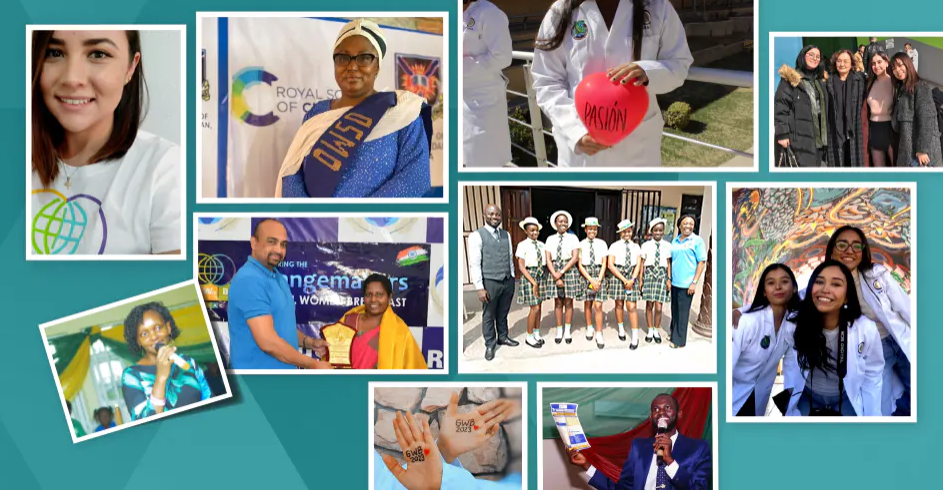
Collage with images from Global Women’s Breakfast events worldwide. Source: IUPAC
The Centre of Competence "Clean&Circle" was presented in the talk by Prof. Pavlina Dolashka. She spoke about the main modules of the project as well as the state-of-the-art equipment now available to Bulgarian scientists thanks to it. Prof. Dolashka emphasized that women are strongly represented both in the management of the Centre and in its network of experts.
"Thanks to our participation in this centre, we have received the most modern equipment for studying all environmental pollutants and for addressing these important issues. The equipment will be placed in a special water laboratory and in other laboratories for solid waste, located in the new building of the centre, which is currently under construction." – explained Prof. Dolashka to the audience.
She added that, in her view, nature was created with its own beauty and purity. Plants, animals, and people need clean air, clean water, and a clean environment free of solid waste. This is why Clean&Circle conducts in-depth research on pollutants and develops technologies for their purification.
Other presentations at the event were delivered by Dr. Ivalina Trendafilova – recipient in 2022 of the National Award of the “13 Centuries of Bulgaria” Fund for young talents in contemporary art and science, for innovative achievements and postgraduate specialization at European universities – as well as by Assoc. Prof. Dr. Boryana Trusheva, who ranks among the top 2% of scientists worldwide with the greatest contribution to modern science, according to Stanford University’s ranking.


