 English
 Български


- Tuesday, 14 February 2023
A method for detecting the SARS-CoV-2 virus in wastewater, developed under the project “CoV-Water,” gained worldwide recognition after the prestigious Swiss journal Water published an extensive article about it. The method was developed by experts from “Sofiyska Voda,” part of Veolia, in partnership with the Laboratory of Environmental Biotechnology, Department of General and Applied Hydrobiology, Faculty of Biology at Sofia University, through the Centre of Competence Clean&Circle.
The method enables early warning of coronavirus spread in different communities. In the article, entitled "Comparison of Two Methods for SARS-CoV-2 Detection in Wastewater: A Case Study from Sofia, Bulgaria", the project team’s work and the achieved results are described in detail.
Using four different RNA concentration methods, the team of “Sofiyska Voda” and the project partners found that the main factor hindering the successful identification of the virus is the presence of PCR inhibitors in wastewater. The most effective way to overcome their presence proved to be the use of a specialised polymerase. The study data further showed that using such an enzyme increases detection efficiency from 1.9% to 70.5% in samples with a control virus.
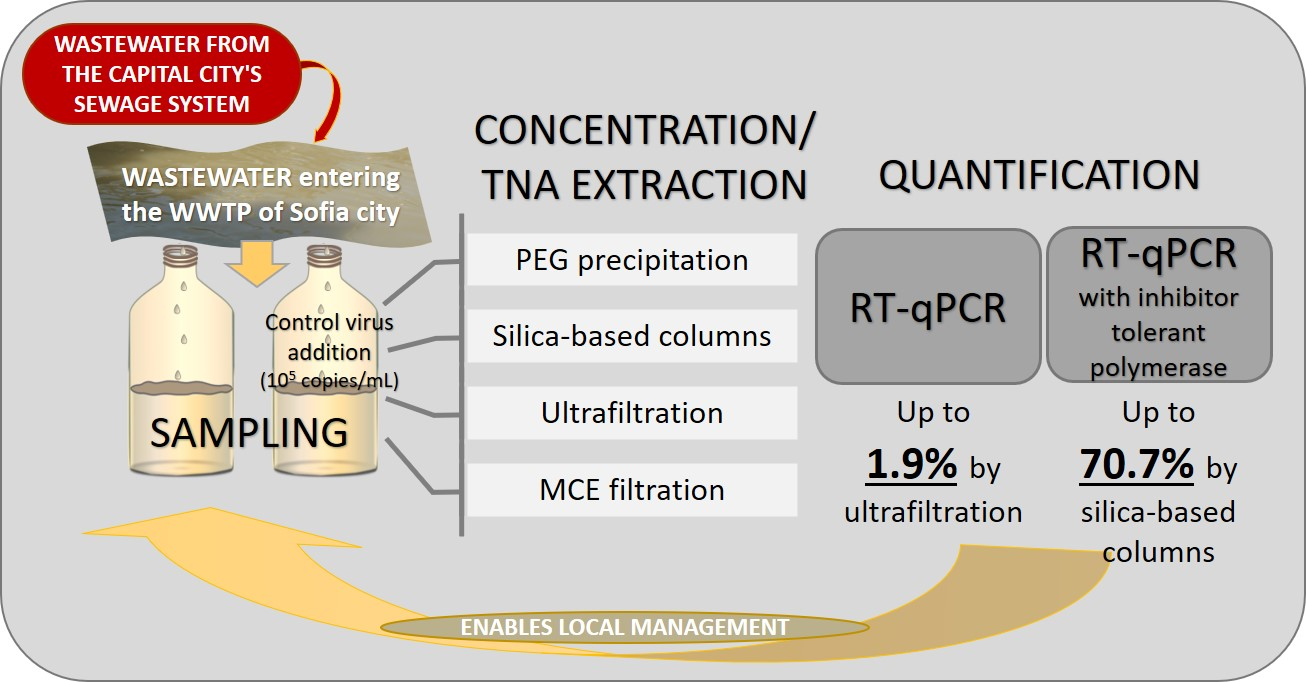
Graphical summary of the method proposed by the experts
The authors of the article are Prof. DSc Yana Topalova, coordinator of the Clean&Circle project; Assist. Prof. Dr. Slavil Peykov from the Faculty of Biology, Sofia University “St. Kliment Ohridski”; Assist. Prof. Mihaela Belukhova from the same university; and Vesela Stefanova, Senior Manager at Sofiyska Voda.
The full article is available in the journal Water


