 English
 Български


- Wednesday, 01 February 2023
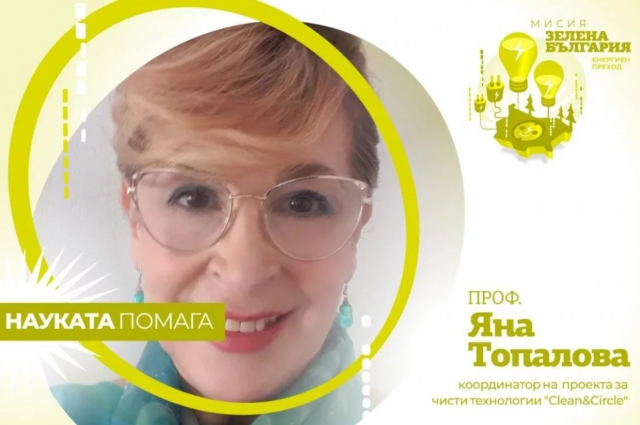
In an interesting interview for the MOVE.BG platform, the coordinator of the Clean&Circle project, Prof. DSc Yana Topalova, presented the work of the center and the prospects for the circular economy and sustainable development. The interview is from November 2022 and part of the series "Mission Energy Transition by MOVE BG".
How we perceive waste is a key question for societies in Europe today: is it garbage or a resource?
Correct terminology is an important first step toward a successful circular economy, a successful energy transition, and overall toward implementing the sustainable development strategy. Garbage is something we do not use, that we throw away, and that we "do not care about." The circular economy aims to change this model—from "we don’t care" to "why it matters that we care." That is why the circular economy does not speak of garbage but of resources.
A resource that can help us in daily life, in the economy, and in society.
A resource that can help build a functioning circular economy and achieve the goals of the European Green Deal. The Deal, commonly referred to in Bulgarian as the Green Deal, is the EU’s large-scale strategy for long-term development and reforms, whose main task is to make Europe the first climate-neutral continent by 2050—that is, to produce only as many greenhouse gas emissions as the planet can naturally absorb.
An important part of the Green Deal is the attitude toward waste: an attitude in the context of building a functioning circular economy. This is also a task pursued by Prof. Topalova’s team at the “Clean&Circle” center.
“The idea of the circular economy is a strategy that requires wide popularization so that the whole picture is seen when making ecological decisions, where the most important elements of this picture are resource efficiency, energy efficiency, and the application of high, realistic technologies to achieve them,” Prof. Topalova shared at the start of our conversation and added:
“Combining these three challenges—resource efficiency, energy efficiency, and high-tech solutions—in the best way is no longer an easy task. It creates difficulties because it requires, first—understanding, second—awareness, third—sufficient investments for advanced technologies, and fourth—commitment from businesses and the state to stimulate these processes to be considered in their entirety.”
Sludge as a resource
Now let’s look at waste as a resource through a concrete example.
Did you know that each year in Europe over 17 kg of sludge per person comes from wastewater treatment plants?
One of the latest reforms proposed under the Green Deal is the Clean Air and Water Package, announced by the European Commission a few weeks ago. It introduces several important changes. First, mandatory wastewater treatment plants in settlements with 1,000 inhabitants—the current requirement was for settlements with over 2,000. The reason is to maximize water reuse.
Another key proposal in this package concerns sludge generated during wastewater treatment. On one hand, more treatment plants mean more sludge. On the other hand, as part of the Green Deal, the proposals aim for sludge to be used in a circular way.
The Commission proposes that by 2040 all wastewater treatment plants become energy-neutral, producing their required energy through clean technologies. One of the main resources proposed for this purpose is precisely sludge.
“To ensure that the wastewater sector not only improves water quality but also moves toward climate neutrality and a circular economy, a binding target for energy neutrality is introduced for the entire sector at the member-state level. This means urban wastewater treatment plants will need to significantly reduce their energy consumption and produce energy through renewable sources (e.g., solar and wind power and particularly biogas production— emphasis mine—ed.). This will be achieved through energy audits and replacing fossil fuel energy with renewable energy.
EU countries will also be required to monitor industrial pollution at the source, to increase opportunities for sludge reuse and reuse of treated wastewater, ensuring valuable resources are not lost.”
This is stated by the European Commission in its proposal to amend the Urban Wastewater Treatment Directive, presented on October 26. Sludge is rich in phosphorus and is also used in agriculture, but due to concerns about soil and food contamination in several member states, including the leading economy Germany, the Commission emphasizes sludge’s importance for energy production—“using sludge for biogas production that can replace natural gas.”
In Bulgaria, there is a similar example developed by “Clean&Circle.” The model is used at the wastewater treatment plant in Kubratovo, where biogas produced in methane tanks currently covers 115% of the facility’s needs, Prof. Topalova explained.
“In other words, they cover 100% of their needs from sludge alone, with 15% left for sale. This is because both primary and secondary sludge are combined.”
The Kubratovo treatment plant, however, is one of the few in Bulgaria with methane tanks and one of the few examples of sustainable biomass use for energy. It was also highlighted as a good example in the European Environment Agency report “Beyond Water Quality—Sewage Sludge Utilisation in a Circular Economy,” published earlier this year.
Innovation in action
Prof. Topalova shared that “Clean&Circle” continues its work on sustainable sludge utilization and will soon introduce a technological innovation developed by the center that will improve and simplify the process.
“We created a control system based on molecular fluorescent analyses that can be automated with sensors and robotized. In other words, the entire input-output process will be robot-controlled, ensuring the cleanest possible energy production, because the automated technology will constantly provide information on what to change and improve.
We plan for the data collected by the robots to be available to users in a very simple way—via a phone app—so they can receive instant feedback and manage the technologies through their smartphones.
The idea is to secure the technology to such an extent that people get everything they need from the robots without having to be molecular process experts—that is our job, not theirs as users of the technology.
They should be technology users, just as we are smartphone users.
This technology is the center’s newest discovery, now being prepared for patenting, and we are seeking skilled IT specialists to build the app. The Kubratovo plant operator has already shown interest in implementing it. This way we will create a demonstration site so that others can see the technology and want it.
This model is very promising in Bulgaria, since as of today there are over 300 methane-generating installations of various types. If all of them switched to such control, making the energy mix manageable—imagine how beneficial that would be. Not to mention how much surplus biomass we have.”
Biomass and energy
Biomass is all around us and is an important part of circular economy and sustainability concepts. Biomass includes all organic waste from human activity, organic by-products from the animal world, all organic products from the plant world, as well as all waste from their use.
In Bulgaria, discussions on biomass for energy often focus on challenges of wood use or recall unpleasant waste crises from past years.
Currently, biomass for energy is the main renewable energy source in the EU, according to the European Commission. Its share is 60% overall, and in the heating and cooling sector, 75% of produced bioenergy is used.
“Biomass for energy production must be produced, processed, and used sustainably and efficiently [emphasis mine—ed.] to optimize the reduction of greenhouse gas emissions and preserve ecosystem services,” the EC explains and adds:
“Biomass can be used for heating, electricity generation, and transport fuels. Increasing biomass use in the EU can help diversify Europe’s energy supply, create growth and jobs, and reduce greenhouse gas emissions. It is also needed in electricity production to balance variable renewable sources.”
Historically, the use of biomass for energy is not new, Prof. Topalova reminds us with the example of how grandmothers would carry manure to a pit, where anaerobic processes released biogas used to heat cow farms.
“This is not new, nor high-tech. But the point is to apply modern science achievements so that energy is produced in a new, ecological way.
When biomass is used sustainably for energy, we mean biogas production. Biogas is a multicomponent mix of methane—the energy source—some carbon dioxide, which lowers energy value, and some hydrogen.
For high-quality biogas—that is, methane-rich with high energy value—more than just piling manure in a pit is needed. Facilities, controlled and manageable technologies are required, and much has already been achieved in this regard.
For biogas to be a desired energy source with a predominant methane content—at least 60% methane—the feedstocks must be properly composed and mixed to create an environment for methanogenic consortia. This points us to the microbiology and biotechnology aspects belonging to high technologies.
Our new technological innovation mentioned earlier is an important step in this process.
And what are the main feedstocks?
The feedstocks are surplus activated sludge—primary and secondary—from wastewater treatment, where the final step is anaerobic sludge utilization for biogas production to cover the plant’s energy needs. Such is the case at the Kubratovo plant.
Other feedstocks are agricultural residues—corn stalks, straw, and other biomass. Applications can vary—not only methane production. But these biomass components can also be placed in methane tanks for biogas production.
Another feedstock is food waste, which also produces biogas.
Mixes of food waste, agricultural residues, and sludge in smaller towns can make blends that, when placed in methane tanks, generate energy to supply the whole settlement.
We have such a strategy.”
Clean technologies for the energy independence of small settlements
The strategy based on using the three types of waste for biomethane production can make small settlements fully circular and energy-independent, Prof. Topalova explains.
The strategy covers the entire energy provision of settlements, so its practical application foresees various activities: awareness campaigns for smart energy use, measures for building energy efficiency, and rooftop photovoltaics.
“This strategy demonstrates in practice how a familiar technology like biomass use can become high and clean technology.”
Another element: biomethane production leaves mineralized sludge, which “Clean&Circle” proposes to reuse circularly—by creating compost that can fertilize fields and gardens.
“If we add components we have designed at the Center, it can become biofertilizer for houseplants, tomatoes, aloe vera, and other crops.
We already created three types of biofertilizer based on enriching compost with specialized plant groups, to produce quality food products.
That’s circular economy.”
The strategy in the current context: war and energy security through clean technologies
Why is this strategy important?
We present this achievement in today’s context, because science often provides answers before challenges and crises occur.
A few weeks after Russia’s war against Ukraine, the European Commission proposed the emergency energy plan “REPowerEU: Joint European Action for more affordable, secure and sustainable energy.” REPowerEU aims to rapidly reduce Europe’s dependence on Russian fossil fuels by accelerating the green transition and uniting efforts toward a sustainable energy system and functional energy union.
Main action areas are:
- energy savings through efficiency and preparedness;
- diversification of energy supplies;
- rapid replacement of fossil fuels through accelerating Europe’s clean energy transition and smartly combining investments and reforms.
One of the main clean energy technologies highlighted in the plan is biomethane production. The Commission proposes to increase annual biomethane output from today’s 3 billion cubic meters (bcm) to 35 bcm by 2030. This biomethane can directly replace natural gas in industrial, energy, and heating facilities, the EC explains.
“The action plan proposes overcoming barriers to increased sustainable biomethane production and use, and facilitating its integration into the EU gas market,” the EC notes, adding:
“As part of the action plan, the Commission establishes an industrial biogas and biomethane partnership; works with member states on national strategies; promotes cooperation with neighboring and candidate countries; cooperates with national authorities and gas transmission operators to lower costs; encourages new infrastructure; fills gaps in R&D, innovation, and demonstration; facilitates financing; and fosters biogas energy communities.”
In this context, Prof. Topalova’s team’s strategy for small-town energy independence via sustainable biomethane production gains even greater importance.
High technologies in action
The strategy includes two innovations, Prof. Topalova explains. First, all feedstocks are non-homogeneous, a challenge for methane facilities. Here, the center applies an innovation from German partners: installations that mix and homogenize waste, treat it with ultrasound, and shorten the initial processing phase. Since biogas production normally takes 14–28 days, any reduction increases output intensity, she says.
The second innovation, developed by “Clean&Circle,” is the robotic system for feedstock improvement mentioned earlier.
“We are working so that the client receives a product that is easy to use. To get energy the easy way.”
What is missing in this scheme? Prof. Topalova points to the carbon footprint. Currently it cannot be calculated, as it depends on the specifics of the settlement where the strategy is applied.
“Every new technology must be integrated into the environment, with a special calculator estimating its carbon and greenhouse gas footprint, depending on the region. Mitigation comes with tree belts, water areas, etc.
We can dream big, because when we build a comprehensive energy-from-waste strategy, combining CO₂ emissions, methane use, and embedding it in beautiful complexes, we can even make the facilities aesthetically pleasing.
This is the new biophilic trend—integrating technology beautifully. Not just trees, but water gardens, green roofs, solar panels, and green walls.
We can achieve not only energy, but also a pleasant life.”
What is needed to make this vision reality?
First, the will of municipal authorities, Prof. Topalova explains. Second, municipal councils’ agreement to link it to the water and waste cycle. Then, the “Clean&Circle” team is ready to assist municipalities with EU program applications for funding.
The model can also be implemented in parts if municipalities lack full financing, she adds. It can even be profitable, since elements like fertilizer sales from mineralized sludge can bring income.
For Prof. Topalova, the key is to create a model town—a showroom —to inspire others. A similar model exists in France, where a Riviera town serves as a showcase “for other municipalities to learn, see, and adopt the technologies.”
“Once they see the model in practice, everyone will want it.”
What is the energy transition for Bulgaria?
We end the engaging conversation with Prof. Topalova with the question we ask all participants in the “Mission Energy Transition” initiative: what does the energy transition mean for Bulgaria?
“Energy is the basis of everything—human life, human activity, from every perspective.
Without energy, nothing can happen.
The energy transition to using energy that sustains human life and economy in harmony with evolution and the environment, without harming it but preserving the planet—that is the most humane and most economically beneficial thing.
However, I want to add a note—the energy transition can happen with very advanced technologies, and we live in a world without limits for technology. But it must always remain humane.
The balance must be kept—the hardest part—between social tolerance, economic efficiency, and the environment. This is what the ESG standards mean. Nothing can be taken out of this balance.”
Source: MOVE.BG


